Welcome parents and educators! Coloring isn’t just a fantastic way to develop fine motor skills and unleash creativity; it’s also a wonderful gateway to sparking curiosity about the real world. Our Magical Spring Gardens Vol. 2 collection transforms familiar, everyday objects into tiny, whimsical homes. As your little ones color these enchanting scenes, you can share these fascinating educational facts with them!
In our collection, a giant antique brass microscope becomes a cozy house nestled among blooming bluebells. Did you know that the first compound microscopes were invented in the late 1500s? Early scientists used specially curved pieces of glass called lenses to bend light, making tiny objects look much larger than they actually were. Thanks to the invention of the microscope, we discovered plant cells, bacteria, and a whole hidden universe of microscopic creatures!
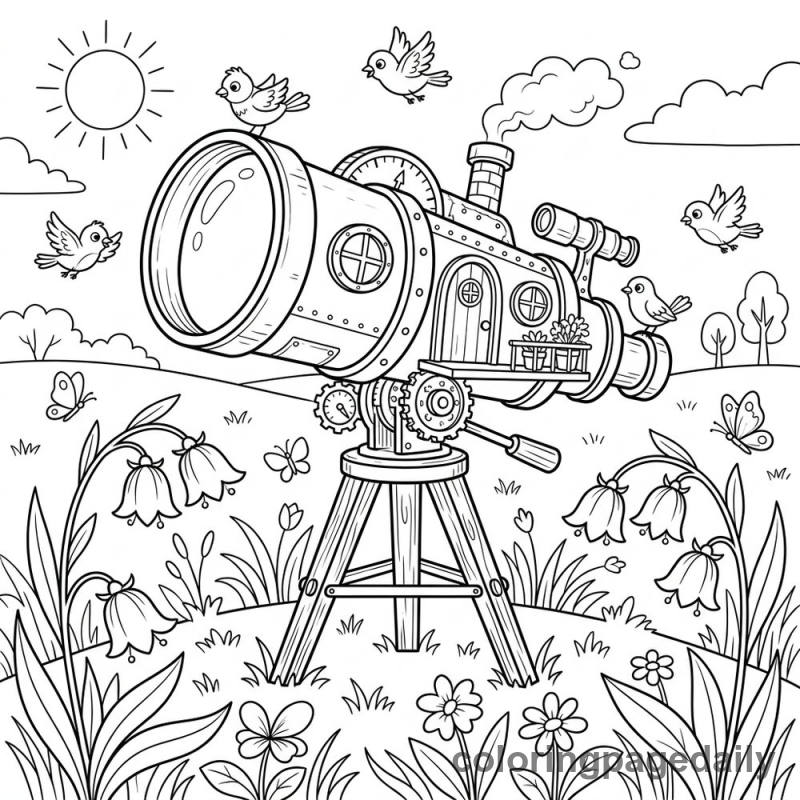
Similarly, telescopes use lenses and mirrors, but they do the exact opposite—they gather light to make faraway objects like the moon and planets look incredibly close! The famous astronomer Galileo Galilei built his own telescope in 1609 and was the first person to study craters on the moon. While coloring the Magical Telescope Spring House, ask your children what they would want to look at if they had a giant telescope in their backyard.
How did a giant seashell end up in a meadow of dandelions? It’s magic, of course! But in the real world, seashells are incredible scientific structures. They are actually the protective outer skeletons of sea creatures called mollusks. As a mollusk grows, it extracts salt and minerals from the ocean water to secrete calcium carbonate, building its shell from the bottom up to make it bigger and stronger.
Bonus Spring Fact: The giant dandelions surrounding our seashell house are incredible survivors. Their fluffy white seed parachutes can be carried by the wind for up to five miles away from the parent plant!
Long before airplanes were invented, humans took to the skies in hot air balloons. Our Magical Balloon Basket House features the classic woven wicker basket base. Have you ever wondered why balloon baskets are made of wicker? It is because the woven wood is lightweight, flexible, and absorbs the impact of landing much better than rigid materials like metal or plastic.
But here is the most fun historical fact of all: the very first passengers in a hot air balloon back in 1783 weren't humans. They were a sheep, a duck, and a rooster! The duck was brought along because it was already used to flying high in the sky, while the sheep was chosen to see how a land animal would handle the high altitude.
Next time you print a page from the Magical Spring Gardens Vol. 2 collection, take a moment to read these fun facts with your young artists. Combining art with science and history creates a richer, more memorable learning experience!
This article is part of Magical Spring Gardens Vol. 2 — browse all 4 coloring pages