The newest additions to our Future Space Exploration Vol. 2 collection have officially landed! This update introduces a fantastic mix of highly advanced robotics, mysterious dwarf planets, and futuristic transport systems.
While our previous updates covered metallic shading and deep-space backgrounds, today we are focusing on how to bring your scenes to life using glow effects, motion techniques, and icy color palettes.
When we think of planets, we often imagine the rocky surface of Mars or the swirling gases of Saturn. But the outer edges of our solar system are incredibly cold!
Take our new Pluto coloring page, for example. Pluto features a massive, heart-shaped glacier known as Tombaugh Regio, made primarily of nitrogen ice. When coloring ice, try not to leave the page completely blank. Instead, lightly shade the edges of the craters and the glacier with pale blues, soft lavenders, and faint greys. This gives the ice dimension and makes it look freezing cold rather than just flat white.
Deep space is incredibly dark, meaning futuristic technology would rely heavily on artificial lighting. You can make the technology in our coloring pages look truly advanced by adding a glowing effect to antennas, sensors, and communication panels.
To create a "glow" on the Obelisk Space Relay Station, choose a bright neon color (like cyan, lime green, or hot pink). Color the very center of the light source with a pale yellow or leave it white, then lightly rub your neon crayon in a soft circle around it to create a "halo." This simple optical illusion tricks the eye into seeing a glowing light against the dark machinery.
Space exploration is full of movement, from rovers crawling over jagged asteroids to cargo transports zipping across the lunar surface.
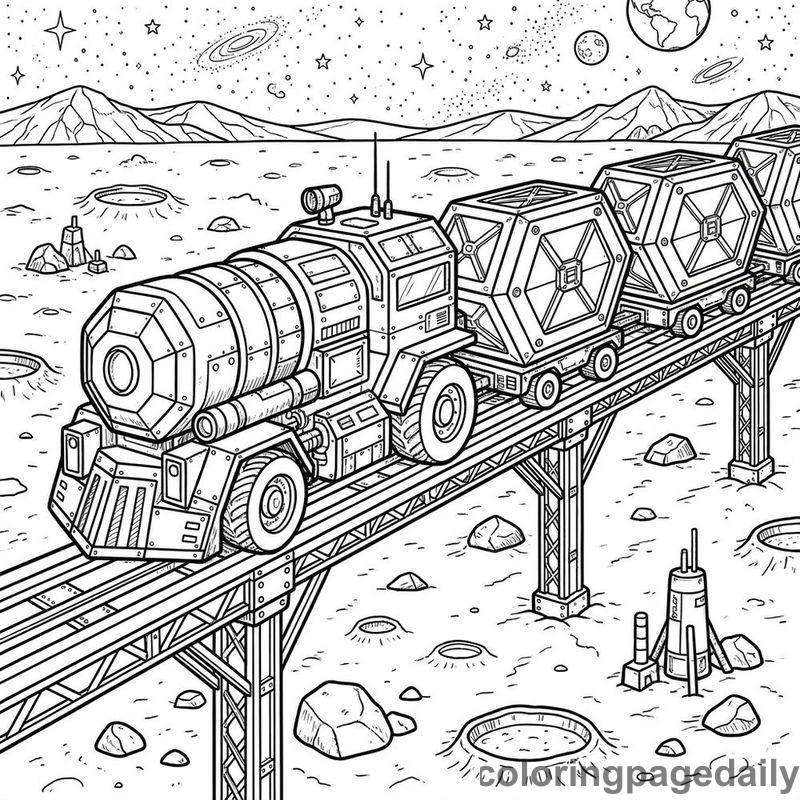
To show that the Lunar Mining Cargo Train is moving fast along its magnetic track, use "directional shading." Instead of coloring the background in random scribbles, use long, straight strokes that run parallel to the train's path. These act as subtle speed lines.
For slower, heavier machinery like our Eight-Legged Space Exploration Rover, you can show motion by adding tiny puffs of "dust" around the mechanical feet. Use a grey or brown colored pencil to lightly draw small clouds kicking up from the rocky asteroid surface. It instantly grounds the rover and makes the scene feel active!
Grab your favorite coloring supplies and blast off into these new pages today. We can't wait to see the creative ways you and your young artists bring these cosmic scenes to life!
This article is part of Future Space Exploration Vol. 2 — browse all 9 coloring pages