Welcome to the latest update for our Future Space Exploration Vol. 2 collection! Our newest batch of coloring pages invites young artists to explore the intersection of raw, untamed space environments and highly advanced human engineering. In this update digest, we’re sharing top coloring tips to help students and children make these futuristic machines pop against rugged cosmic landscapes.
Space isn't just empty blackness—it's filled with dusty moons, icy dwarf planets, and rocky asteroids. When tackling our new off-world scenes, encourage kids to move beyond basic grey crayons.
Asteroids and lunar surfaces can feature subtle hints of brown, dusty red, or even icy blue. A great technique for rocky surfaces is stippling—making tiny dots with a marker or colored pencil to create the illusion of rough gravel and deep craters.
Real-world celestial bodies offer fantastic inspiration for this. For instance, when coloring Pluto, young astronomers can blend stark white with pale pinks, tans, and cool blues to represent its freezing, complex surface. Pluto's famous heart-shaped glacier, known as Tombaugh Regio, is primarily made of frozen nitrogen and carbon monoxide, giving it a bright, highly reflective appearance compared to the darker, cratered regions around it.
How do you make a sleek lunar vehicle stand out against a cratered moon? The secret is using "hazard and high-visibility" colors!
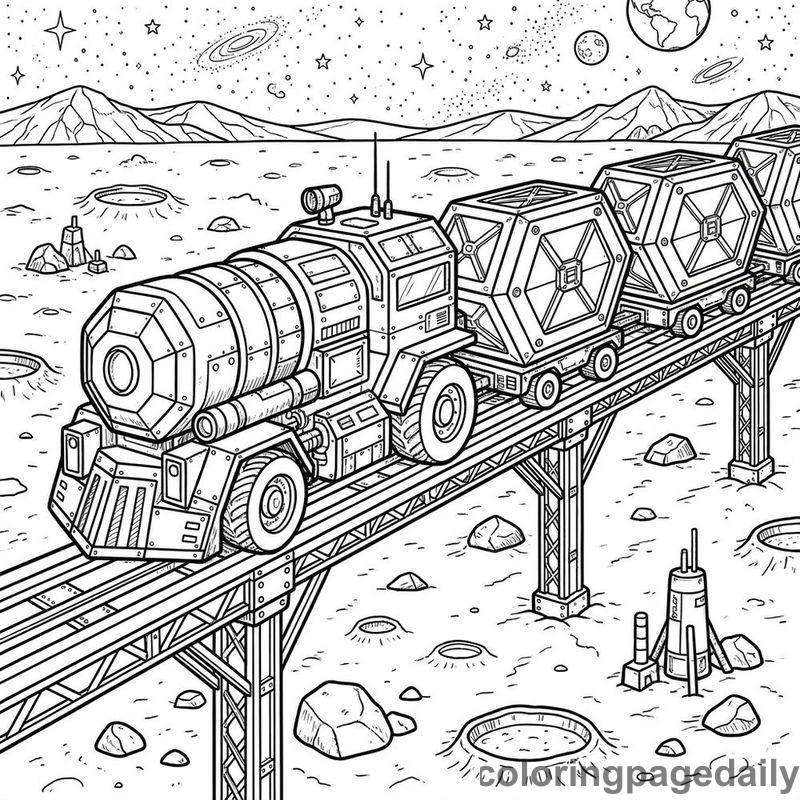
In real-world aerospace engineering, important components are often painted bright gold, bold orange, or stark white to reflect harsh solar heat and remain highly visible in the dark vacuum of space. By coloring spacecraft, robotic rovers, and futuristic trains with bright, contrasting colors, the machinery will instantly pop off the page and draw the viewer's eye right to the action.
Our new update also features deep-space communication buoys and massive orbital relays. These structures rely heavily on solar panels, which present a fantastic opportunity to practice gradient coloring.
Instead of coloring solar panels a solid flat blue, try blending a deep navy into a bright, icy teal or vibrant purple. This mimics the reflection of distant stars and nebulas on the glossy, geometric panels of our relay stations. Leaving a sharp, uncolored white line diagonally across the panels can also simulate the gleam of starlight!
These new additions to the collection are perfect for sparking conversations about off-world engineering, astronomy, and the future of human spaceflight. Grab your brightest markers and your dustiest rock-colored crayons, and prepare for liftoff!
This article is part of Future Space Exploration Vol. 2 — browse all 9 coloring pages